
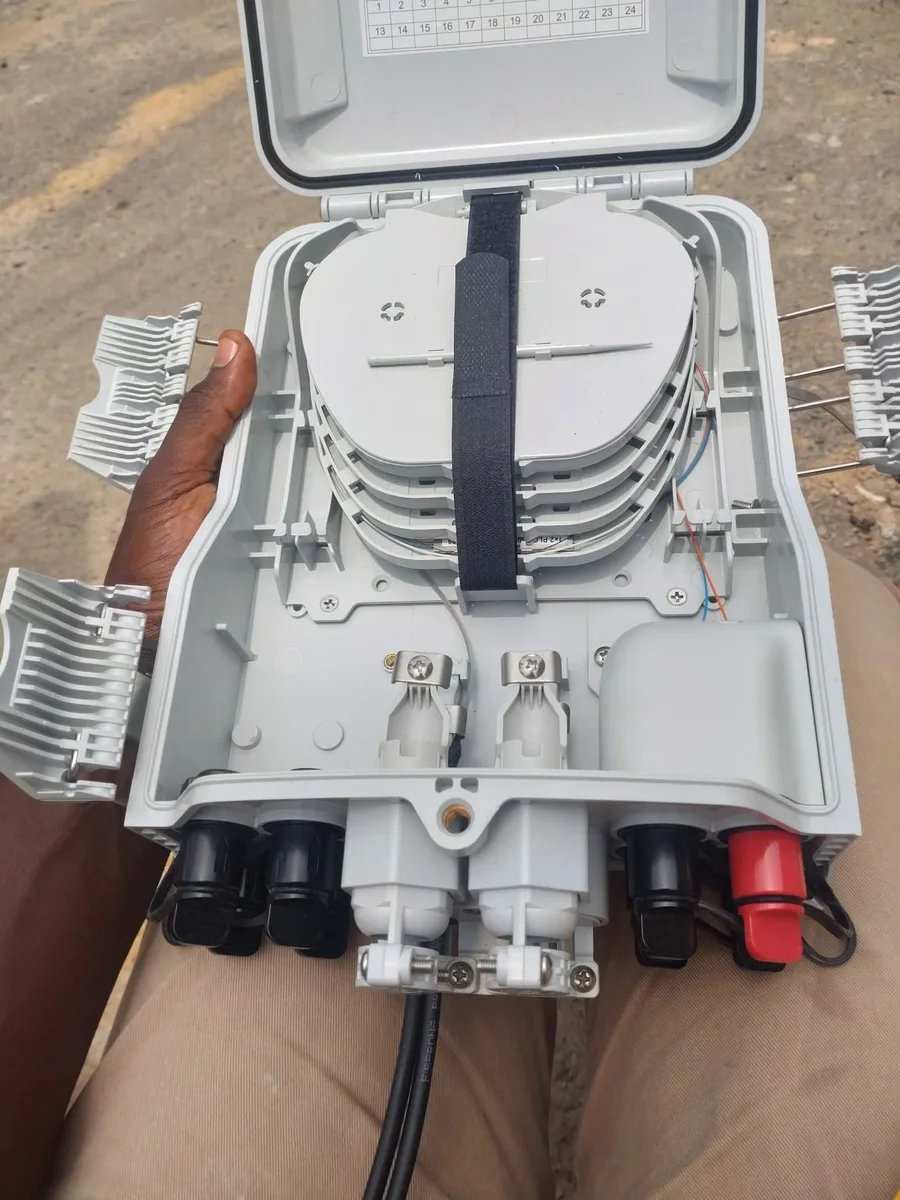
Direct answer: hand over a controlled record, not a spare-port count
On a rural African FTTH rollout activated in phases, every unused fibre or port should have a traceable identity, an assignment state, an evidence state and a person authorized to release it. Unused does not mean tested, unreserved or ready to connect. Give the next team the current drawing and test references together with unresolved work. This guide covers custody between construction and operations, not a calculation of expansion capacity.
Identify the physical resource end to end
Record cable-section ID, fibre number or colour, closure or box ID, tray position and termination at both ends where applicable. Distinguish an unspliced fibre from a terminated adapter position and from a splitter output. These are different resources and should not share an ambiguous 'spare' count. If the field label disagrees with the drawing, preserve both observations and resolve the discrepancy before the next assignment.
Keep assignment and test status in separate fields
A fibre may be reserved for phase two and have passing acceptance evidence; another may be unassigned but not yet tested. A single green/red status cannot express both facts. Use separate fields for allocation, required tests and defects, then derive a release decision. Missing evidence is an open requirement, not proof of damage. Likewise, a test result does not cancel a reservation made by the operator.
Preserve evidence that another team can find
Link each required result to the actual fibre or port identity, test date, method and relevant settings under the operator's inspection plan. FOA's testing guidance emphasizes identification and documentation. A filename such as 'all passed' without a resource mapping is not enough for the receiving team. Retain native records when the contract requires them and provide a readable index; photographs of the box do not replace optical evidence.
Record unfinished protection and defects separately
List missing identification, incomplete termination, protection issues and known optical faults as distinct open items. State who owns each action and what evidence closes it. Unused entries and connections must retain the protection specified for the installed equipment. The operator's qualified personnel should decide how to assess exposed or disturbed components. Never look into an unknown fibre or disconnect a working circuit merely to identify a spare; use authorized procedures.
Make handover usable where connectivity is intermittent
For remote teams, agree a controlled offline copy of the current register and the place where original evidence is stored. Name the revision owner and the method for reconciling field changes when connectivity returns. Do not assume every rural location lacks connectivity; choose the process for the actual site. Two independently edited spreadsheets can allocate the same resource unless someone owns the authoritative record.
Release the next phase through a named owner
Before activating a new connection, verify that its resource IDs still match the field, required acceptance evidence is complete, defects are closed and allocation is approved. Record the work order and update the register after authorized work. If the route or equipment changed since the test, the operator decides what reassessment is required. Procurement or delivery acceptance alone does not authorize a service activation.
Build the follow-up order from unresolved work
Separate items needed to finish handover from optional expansion stock. Send the supply team anonymized box/interface references and a quantity list for confirmed missing materials, rather than subscriber names or private network access details. FTTH Africa's product and factory pages support matching the supply scope; they cannot certify a field resource as ready. The photograph is a terminal-box reference, not evidence of a completed project or its acceptance.
FAQ: Can untested fibres be handed over?
They can be recorded as open scope with an agreed owner and deadline if the contract permits that handover stage. Do not label them ready for activation when required acceptance evidence is missing.
FAQ: Does a passing test make a reserved port available?
No. Technical evidence and allocation authority are separate. Only the operator's designated owner can change the reservation.
FAQ: Must every old test be repeated before phase two?
Not automatically. The operator should review the acceptance plan, intervening changes and any incidents. Keep the reason for reusing or replacing evidence with the release record.
Unused-resource handover register
| Record field | What to capture | Why it matters |
|---|---|---|
| Resource identity | Section, fibre, box, tray and both endpoints | Prevents a spare label identifying the wrong path |
| Allocation | Unassigned or reservation with phase/work order | Prevents duplicate promises |
| Evidence | Required checks, result references and missing scope | Separates untested from failed |
| Open work | Defect or protection issue, owner and closure proof | Prevents unfinished work disappearing at handover |
| Release | Approver, register revision and authorized next action | Separates custody from permission to activate |
Six checks at the construction-to-operations handover
- Reconcile field labels with the current end-to-end drawing.
- Record reservations separately from test and defect status.
- Index the required evidence against each resource identity.
- Assign every open item an owner and closure requirement.
- Agree the authoritative register and offline update process.
- Record acceptance of custody and the separate authority for future activation.