Direct answer: approve the combination, not just two separate products
Order rural aerial FTTH drop cable, clamps and attachment accessories as a matched, documented set for the intended route. Confirm which part of the cable is gripped, the relevant dimensions and materials, the clamp application and the bracket interface. Neither a fibre count nor a nominal clamp diameter proves the combination suitable. The responsible designer and suppliers must confirm the actual application; this guide does not calculate loading or authorize installation.
Identify the cable's load-bearing arrangement
Record the actual construction drawing: flat or round geometry, dimensions and tolerances, sheath and any separate messenger. Ask which member or cable region the intended clamp is designed to grip. A clamp for one geometry must not be assumed suitable for another because both products are called FTTH. A drawing and product reference are more useful than an informal description such as 'standard two-core drop'.
Check the exact cable-and-clamp pair
Ask the cable and fitting suppliers to identify the approved pair and the evidence required by the operator. Telenco's LX030PU example explicitly discusses compatibility with a named clamp and sheath friction, illustrating why compatibility is more than nominal size. Its span, wind and cable values apply to that specific product, not to FTTH Africa stock. If a proposed pair lacks confirmation, keep it as an open technical item rather than presenting it as a tested kit.
Differentiate anchoring from intermediate support
The design should identify endpoint, intermediate and change-of-direction arrangements. Procurement then selects the specified fitting for each role; it should not assign one clamp to every support by appearance. Confirm the applicable cable and route conditions with the responsible engineer. A stronger-looking clamp does not resolve an inappropriate grip or a missing support arrangement, and published fitting loads are not automatically allowable cable span loads.
Include the interface beyond the clamp
Check the hook or loop, bracket, fastening hardware and pole or wall arrangement as a complete connection. Assign supply of bands, bolts and other required accessories explicitly. A clamp packed without its intended bracket can leave an installation team unable to use it even when the cable fits. Building and support suitability remain engineering decisions; do not invent fastening details for an unknown pole or wall.
Count approved attachment positions, not kilometres
Build quantities from the approved route and connection arrangements. Cable length, number of subscribers and number of clamps are different measures. Reconcile endpoints, intermediate supports, special positions and authorized reserve stock. Any numerical allowance for spares should be agreed for the actual rollout, not copied as a universal percentage. Pack and label materials by connection type or stage so early-phase cable does not arrive without its matching fittings.
Control substitutions and spares by combination
A replacement drop cable may change dimensions or sheath while retaining the same fibre count; a replacement clamp may change gripping or attachment geometry. Require review of the affected pair before approving the change. Keep the old and new references, approval owner and rollout-stage allocation. Stock known-compatible repair combinations rather than an untraceable box of mixed fittings, using the separate restoration-spares guide for replenishment planning.
Use a representative review before scaling the purchase
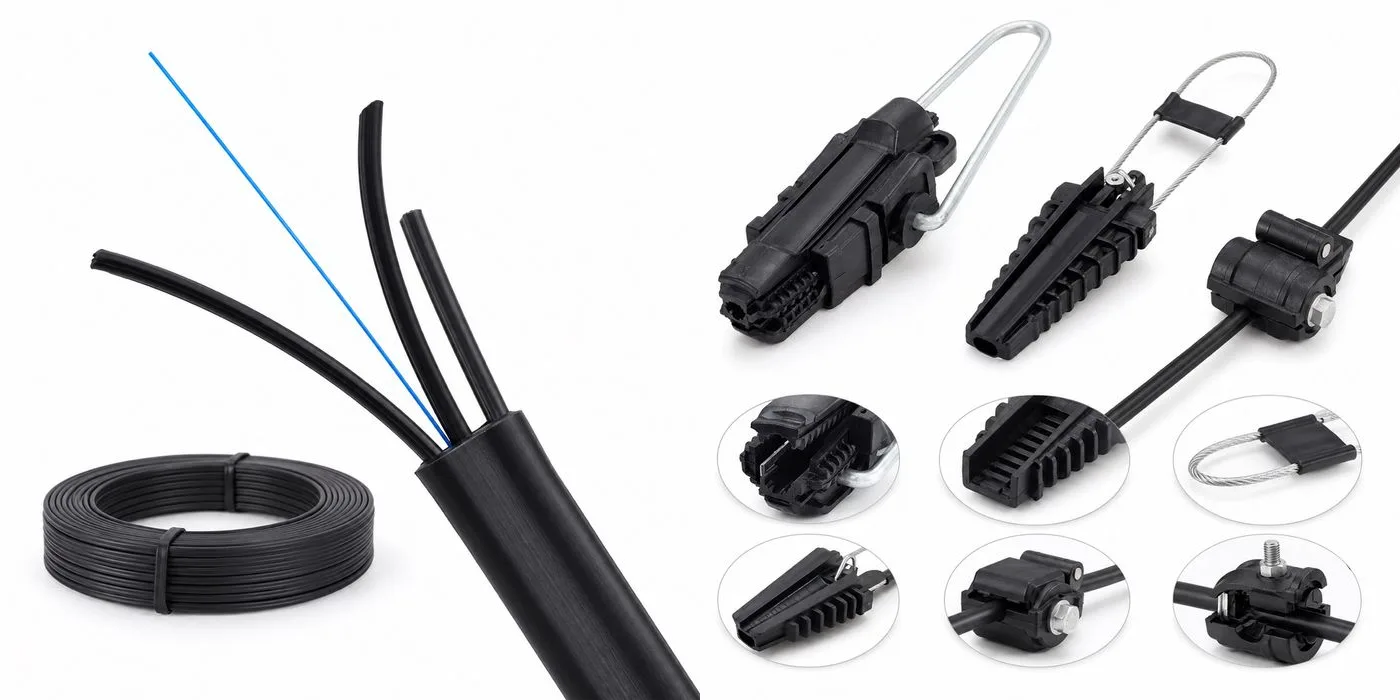
Agree a sample or pilot-kit review with qualified personnel and the operator's acceptance procedure. Verify identity, interfaces, packing completeness and the required combination evidence before bulk release. A visual trial alone is not proof of mechanical performance or long-term reliability. The cover presents product-library options for comparison; it does not depict an installed African project or certify that all shown items form one approved assembly.
FAQ: Does the same cable diameter guarantee compatibility?
No. Geometry, the gripped region, sheath and the intended clamp application also matter. Obtain confirmation for the exact pair and installation conditions.
FAQ: Can one clamp type serve every point?
Only if the approved design and the fitting's documented application support that use. Different roles and attachment interfaces may need different parts.
FAQ: Can a supplier substitute another two-core cable?
Not solely on fibre count. Review construction, dimensions, sheath, route requirements and compatibility with the purchased fittings before accepting the substitution.
Matched aerial-drop procurement matrix
| Item | Information to freeze | Release evidence |
|---|---|---|
| Cable | Exact reference, construction, dimensions and sheath | Approved drawing and relevant datasheet |
| Grip | Clamp reference and member or region it grips | Documented cable-and-clamp compatibility |
| Support role | Endpoint, intermediate or special position | Approved route arrangement |
| Attachment | Bracket, hook, fasteners and support interface | Complete specified accessory list |
| Quantity and change | Position counts, stage kits, spares and substitutions | Reconciled BOM and approval record |
Six checks before releasing a rollout kit
- Freeze the cable drawing and the relevant gripping dimensions.
- Confirm the actual clamp and cable combination.
- Map fitting roles to the approved route positions.
- Include the specified bracket and fastening interfaces.
- Reconcile counts, stage packing and approved spare combinations.
- Close combination evidence and substitution approval before dispatch.