A typical subscriber connection may leave a pole, cross open air, enter a wall and continue through a corridor. Those sections do not place the same demands on the cable. The outdoor part needs weather resistance and, for an aerial route, a messenger or suitable support. The indoor part needs the jacket and installation behaviour specified for the building.
Draw the route in three sections
1. Pole or distribution point to the building
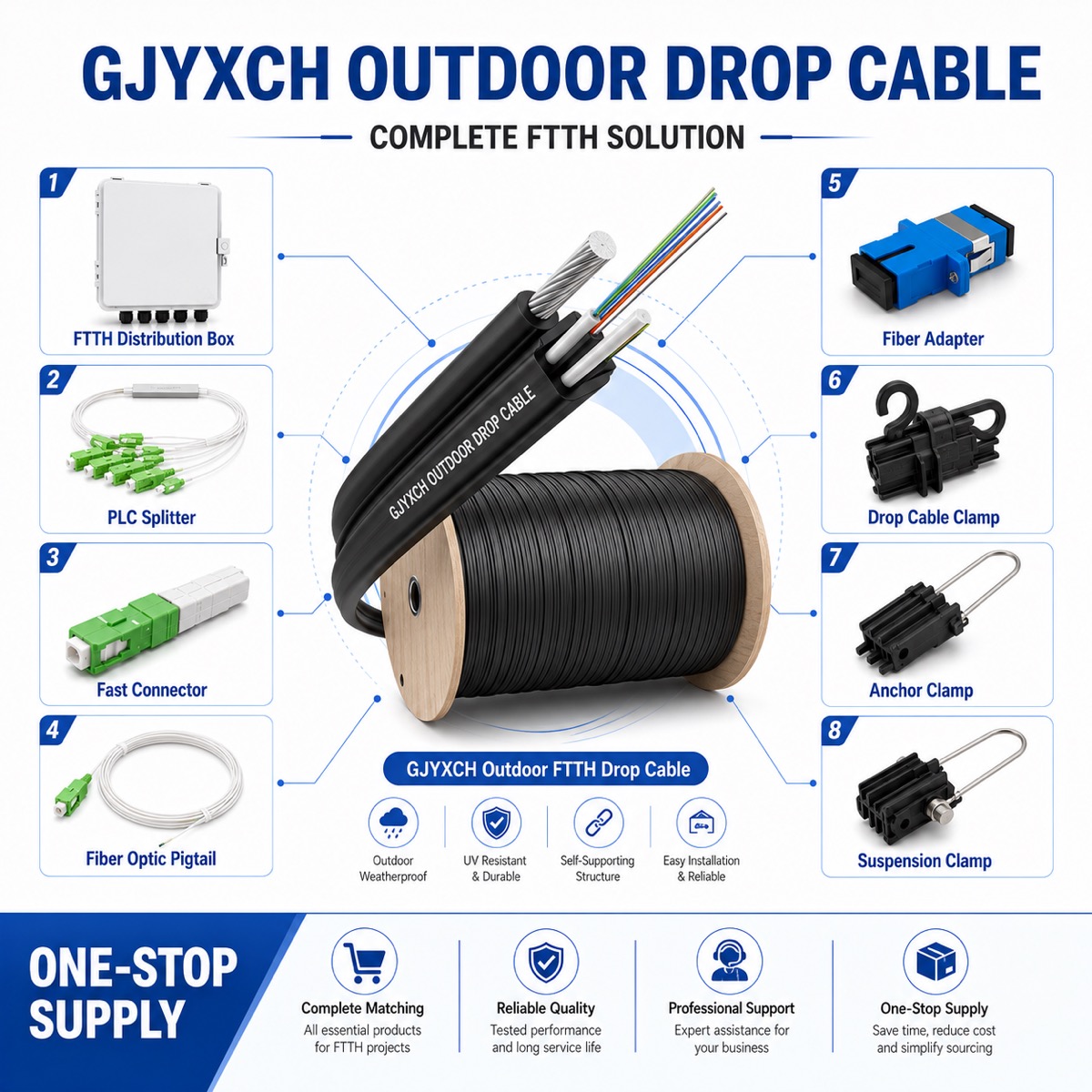
Confirm whether the route is aerial, clipped to a wall or pulled through a small duct. For an aerial section, a self-supporting drop cable such as GJYXCH or a non-metallic alternative may be considered according to the project requirement.
2. Building entry
Mark the point where the outdoor cable ends or transitions. The entry needs weather sealing, bend control and a suitable termination or splice arrangement. Leaving a loop without a planned fixing point often creates sharp bends and future maintenance problems.
3. Inside the premises
Indoor GJXH or GJXFH cable is compact and convenient for subscriber wiring. Jacket material and fire-performance requirements must follow the building specification and local rules. Indoor cable should not be treated as an outdoor aerial cable simply because the distance is short.
ITU-T G.657 fibre is designed for improved macrobending performance in access networks. Category A remains compatible with G.652 applications, while category B is intended mainly for short sections inside or near buildings.
Steel or non-metallic strength members?
Steel-wire and FRP strength members serve different project preferences. The decision may be influenced by electrical isolation requirements, fixing method and the connector or termination process. State the required construction in the RFQ instead of asking only for “1-core drop cable.”
Count the accessories with the cable
- Drop clamps or anchor clamps for aerial sections.
- Wall fixings and protective conduit where required.
- Termination boxes or rosettes at the subscriber end.
- Fast connectors, pigtails or pre-connectorized ends.
- Distribution boxes and splitters at the network side.
A quotation-ready checklist
Send the number of subscribers, average outdoor distance, average indoor distance, installation method, fibre count, required connector arrangement and packing unit. This produces a much more accurate bill of materials than quoting cable kilometres alone.