
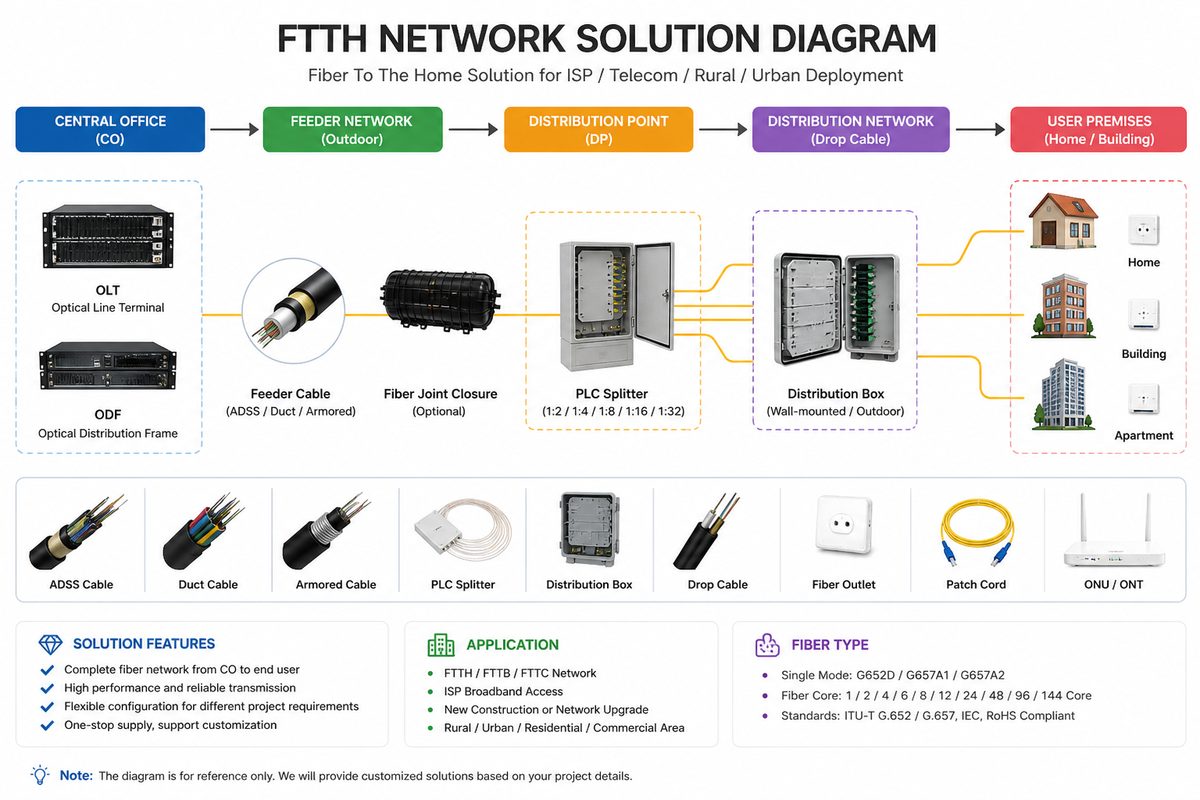
Nigeria's Communications Commission has repeatedly identified metropolitan fibre and last-mile distribution as important infrastructure questions. At project level, that broad challenge becomes very practical: how many fibres leave the central point, where are they divided, and how does each subscriber connection reach the premises?
Send a route sketch before a product list
The sketch does not need to be a formal CAD drawing. Show the central office or handover point, feeder route, distribution areas, expected splitter locations, building clusters and the intended aerial or duct sections. Add approximate distances and subscriber counts.
Break the RFQ into network sections
Feeder and distribution cable
Confirm fibre count, route type, required construction, section length and planned splice points. Outdoor duct, aerial ADSS and direct-buried routes should not be combined under one vague line item.
Distribution and access points
List closures, cabinets or distribution boxes by capacity. State the splitter ratio and whether splitters are cassette, box or PLC module types. Connector type and polishing—such as SC/APC—must remain consistent across the network.
Subscriber drop
Estimate the average and maximum outdoor drop length and indoor length separately. Add clamps, wall fixings, sockets, fast connectors or pre-connectorized assemblies according to the installation method.
If the final subscriber count or route length is not fixed, give a base quantity plus an expected variation. A supplier can then separate firm items from allowance items instead of guessing.
Drum length affects site work
For feeder cable, send preferred drum lengths and the maximum drum size or weight the site can handle. For drop cable, state whether packing is required in coils, reels or cartons and the preferred unit length. Confirm cable printing, drum labels and destination marks before production.
Ask for evidence you can use
- Product datasheet showing construction and dimensions.
- Optical attenuation test record for completed cable.
- Drum and label photos before loading.
- Packing list that separates cable, boxes, splitters and fittings.
- Final accessory count checked against the latest route revision.
One-page RFQ structure
- Project city/state and delivery destination.
- Route drawing and installation method.
- Cable sections with fibre count and length.
- Distribution points, split ratios and connector type.
- Subscriber count and average drop length.
- Printing, packing and inspection requirements.